Adapted from article Chabad.org Staff
On August 3, 2026, the 82nd anniversary of Rabbi Levi Yitzchak Schneerson’s passing, a prison commander stood before a small crowd at the Lukyanivka Detention Center in Kyiv, and acknowledged the unjust persecution, decades ago, of the late Rabbi Levi Yitzchak Schneerson, of righteous memory, father of the Rebbe, Rabbi Menachem M. Schneerson, of righteous memory.
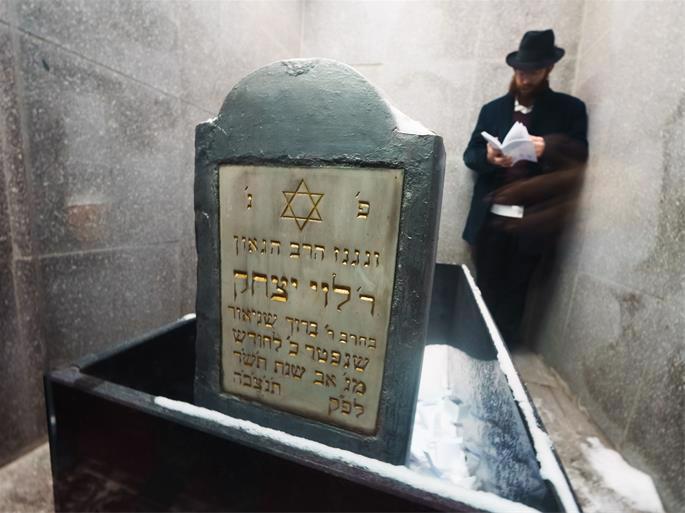
In the early morning hours of March 28, 1939, Rabbi Levi Yitzchak, longtime Chief Rabbi of Dnipropetrovsk, was arrested at his home by the NKVD (the secret police). The next morning, he was transferred to the Lukyanivka Detention Center, in Kiev (today’s Kyiv), where he was beaten and interrogated for months. On October 4, 1939, he was sentenced to five years of internal exile in a remote village in Kazakhstan. Sadly, he passed away on August 9, 1944, and was buried in what is today Almaty, Kazakhstan.
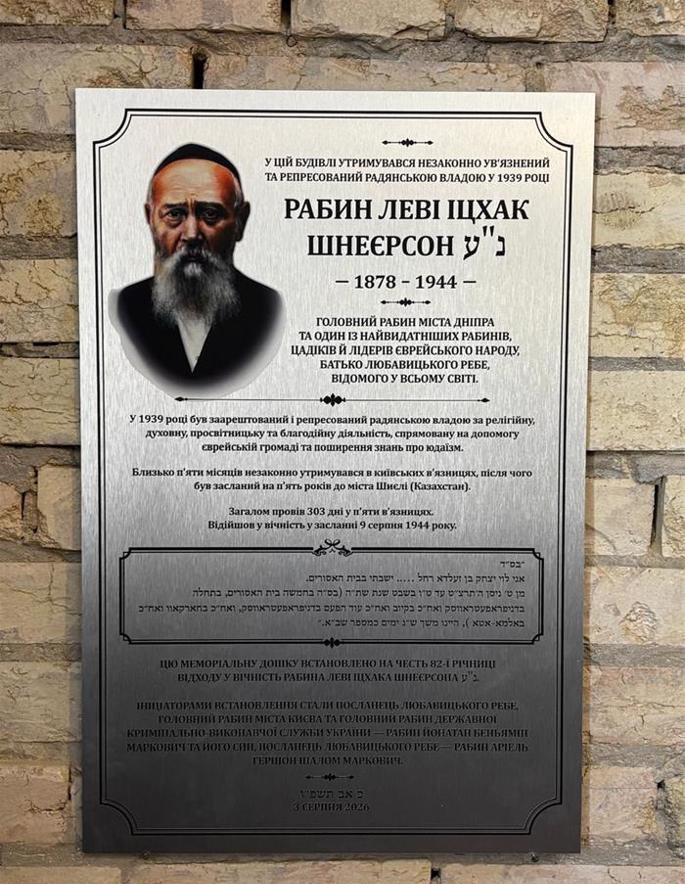
Eighty-two years later, Ukrainian authorities unveiled a plaque honoring Rabbi Levi Yitzchak inside Lukyanivka, which continues to operate as a prison.
Rabbi Levi Yitzchak was born in 1878, and by the time he was in his 20s, he was widely recognized as an authority in Kabbalah and Halacha. After his marriage to Rebbetzin Chana Schneerson, he lived in Mykolaiv, where the couple had three sons, the Rebbe being the eldest. In 1908, he became the chief rabbi of the city known today as Dnipro—a post he held for three decades, during tumultuous times for the Jews. Rabbi Levi Yitchak guided his community through the bloodshed and other tragedies of World War I, the Bolshevik Revolution and the subsequent campaign to destroy Jewish life in the Soviet Union. After the Sixth Rebbe, Rabbi Yosef Yitzchak Schneersohn, of righteous memory, was forced to leave in 1927, Rabbi Levi Yitzchak became the leading rabbinical figure in the Soviet Union.
Just days before Passover in 1939, the NKVD arrested him for “under the guise of religious activity, SCHNEERSON, L.Z., conducts active anti-Soviet agitation of a slanderous and defeatist character.” The warrant continued:
“Maintaining regular contact with his son—the Chief Rabbi of Warsaw, who is a major agent of Polish intelligence—and also with his close relative, the Chief Rabbi of Riga, SCHNEERSON organizes and consolidates cadres of the anti-Soviet clerical underground and is suspected of espionage. [Additionally,] he uses his right to preach weekly in synagogue to slander Soviet power and its leaders….”
The son claimed by the secret police to be Chief Rabbi of Warsaw—and a Polish agent—was the future Rebbe, who was neither of these things. And “the close relative” with whom Rabbi Levi Yitchak was accused of maintaining connections was the Sixth Rebbe, who likewise was not the Chief Rabbi of Riga. And, most importantly, Rabbi Levi Yitzchak was not a spy for a foreign entity. But he was an unbending influential Jewish leader who inspired Jews to hold onto their heritage, which caused him to become a target of the regime.
Over the following months, Rabbi Levi Yitzhak was shuttled between five prisons, including Lukyanivka, and subjected to interrogations that sometimes lasted15 or 16 hours. Sentenced to five years of internal exile, he was sent to the remote village of Chi’ili on the Kazakh steppe. His wife Rebbetzin Chana joined him in Chi’ili, and the two found ways to sustain other Jews in distress even while enduring their own hardships, By early 1944, Rabbi Levi Yitzchak was allowed to relocate to the city then called Alma-Ata. Already gravely ill, he passed away at the age of 66.
After decades of refusing to acknowledge what had been done to Rabbi Levi Yitzchak, in August 1991, just before the fall of the Soviet Union, the KGB formally apologized for its treatment of Rabbi Levi Yitzchak. Documents provided by the KGB relating to Rabbi Levi Yitzchak’s arrest were flown to New York and given to Rabbi Levi Yitzchak’s son, the Rebbe. In 2020, the Kazakh government formally designated Rabbi Levi Yitzhak’s Almaty burial site a National Heritage Site, at an event attended by representatives of the United States and local Kazakh officials.
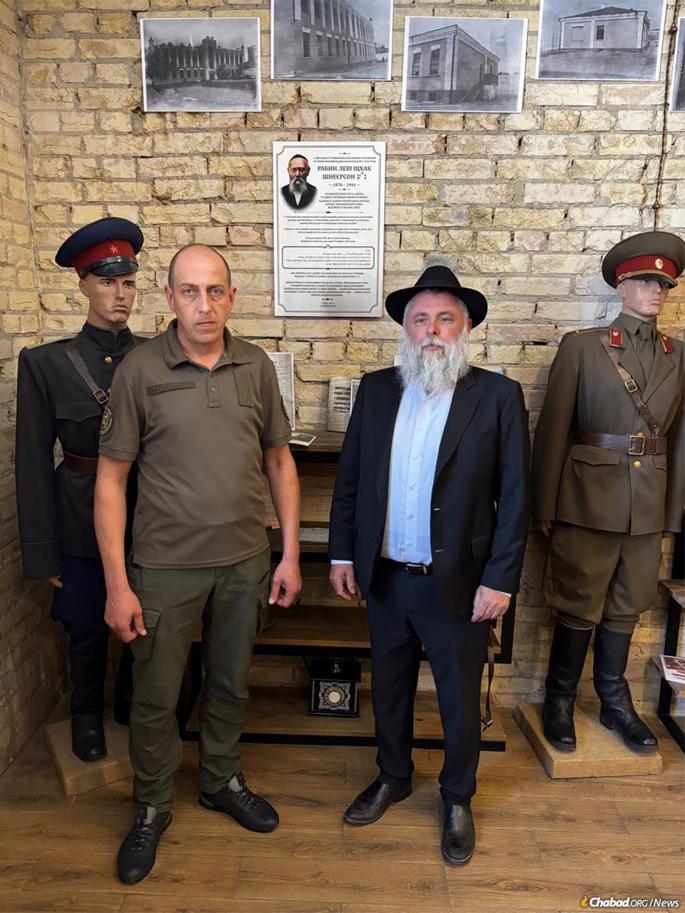
Monday’s ceremony at Lukyanivka continued the historic acknowledgment of Rabbi Levi Yitzchak’s persecution. Rabbi Yonatan Markovitch, of Kyiv, who serves as rabbi of Ukraine’s prison service, together with his son, Rabbi Ariel Markovitch, spent months working with jail administrators to secure a permanent memorial inside the detention center.
“There is profound significance in the fact that on the yahrzeit of Rabbi Levi Yitzchak, we have gathered to establish a memorial at the very place where his freedom was taken from him simply because he was a rabbi spreading Judaism,” Markovitch said.
The prison’s commander, speaking alongside his deputy, reiterated that Rabbi Levi Yitzchak had been held there for no offense beyond serving as a spiritual leader, and that the episode deserved to be remembered and commemorated, rather than left buried in the past.
Together we save lives and restore hope.